
LAIA XR Brings 3D Surgical Planning to RSNA 2026 in Chicago

RSNA 2026, the annual meeting of the Radiological Society of North America, takes place in Chicago from November 29 to December 3. It is one of the world’s leading radiology and medical imaging events, and this year LAIA XR will be there with its own booth and a talk on 3D surgical planning.
This is our first time exhibiting at RSNA, and we arrive after a busy fall. In recent weeks, we shared our vision for 3D surgical planning at the 10th SECLA Symposium, and we gave demos to surgeons at the SECT Thoracic Surgery Update Course and at CNC 2026. Chicago gives us the chance to take that conversation to an international audience of radiologists, surgeons and clinical engineers.
Our RSNA 2026 Talk: 3D Models for Surgical Planning
On Sunday, November 29, from 12:30 to 12:50 p.m., our colleagues Óscar Alonso and José Castellote will take the stage at the Innovation Theater to present “LAIA XR accelerates your 3D modelling workflow for surgical planning.”
The talk starts from a question we often hear in hospitals: how can teams have 3D patient models without preparing them becoming extra work? Among other topics, they will cover oncologic resections, where the relationship between the tumor and nearby structures carries a lot of weight when choosing the surgical approach.
From Imaging Study to 3D Model
Preparation for a complex procedure begins long before the patient reaches the operating room. Radiological imaging shows the team the extent and location of the lesion, and how it relates to nearby organs and vessels. Each modality provides different information, and choosing between computed tomography (CT) and magnetic resonance imaging (MRI) depends on what needs to be seen.
Turning those images into a 3D model is not always straightforward. Standard segmentation and modeling processes can require a lot of manual work or support from a clinical engineering department. Some centers have that support and others don’t. Either way, the goal is the same: useful models for planning, without adding to a workflow that is already demanding.
What We’ll Show of LAIA XR at RSNA
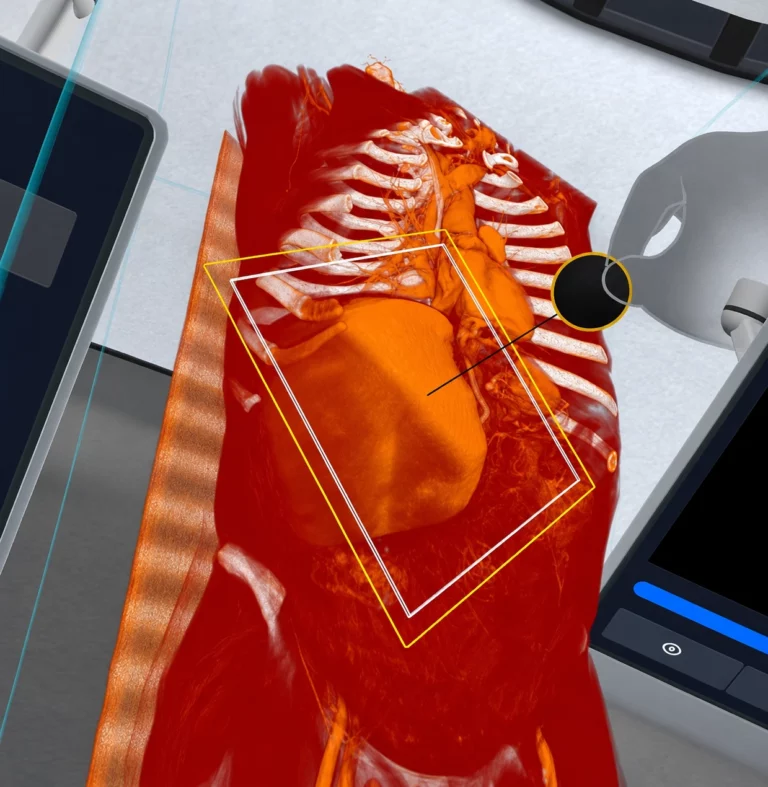
LAIA XR is healthcare software for advanced 3D visualization and surgical planning. It works with CT and MRI DICOM (Digital Imaging and Communications in Medicine) studies, reconstructs them in three dimensions and lets clinicians analyze them on a computer or in virtual reality (VR).
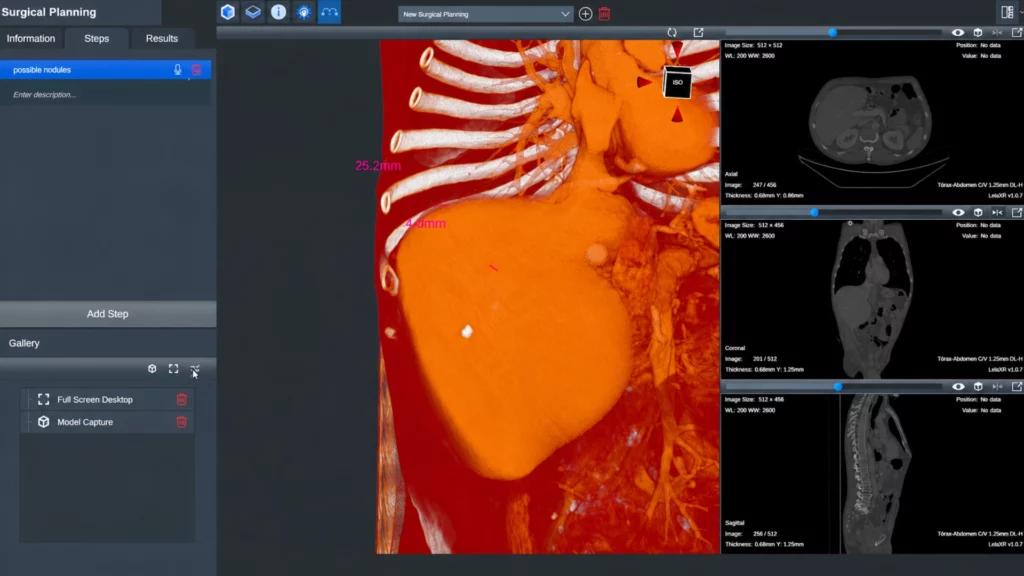
With that reconstruction, clinicians can rotate the volume and view it from any angle they need. They can also review multiplanar reconstructions (MPR), make cuts to isolate the area of interest and take measurements on the anatomy. To see the case another way, they can switch to immersive mode without changing tools.
The result is a spatial representation of each patient’s anatomy that complements the standard reading of 2D images.
Why Seeing Anatomy in 3D Helps
In cancer surgery, knowing where a tumor is is only part of the problem. It also matters how far it is from a major vessel, whether it touches another organ and how the surrounding structures are arranged. All of this shapes the resection options.
Viewing the case in 3D makes it easier to understand those relationships and study them from multiple angles before deciding on the approach. It’s the same idea behind 3D preoperative simulation: arriving in the operating room with the case thoroughly studied.
That’s why this approach is especially well suited to thoracic and hepatopancreatobiliary (HPB) surgery, where vascular anatomy often plays a decisive role in planning.
Virtual Reality: What You Can Try at RSNA
With a VR headset, the model is no longer confined to a screen. Surgeons can move around it, zoom in on a specific area and explore the anatomy as if it were right in front of them.
Not every case calls for it, and not every team works the same way. That’s why in LAIA XR the same study is available on desktop and in VR, and each clinician decides when one or the other is more useful.
What doesn’t change is the tool’s role. 3D reconstruction complements the original radiological studies and the specialist’s judgment, but it does not replace them. It is another way to review anatomical information that is already available.
Where to Find Us at RSNA 2026
If you’ll be in Chicago, come see LAIA XR in action at our booth and talk with the team about how it could fit into the way you work.
- Venue: McCormick Place, Chicago (USA)
- Dates: November 29 – December 3, 2026
- Booth: 3837, South Hall, Level 3
- Talk: Sunday, November 29, 12:30–12:50 p.m., Innovation Theater
We’re heading to RSNA eager to show our work, but also to listen. Conversations with radiologists and surgeons help us more than anything else to keep improving LAIA XR. After all, 3D surgical planning only makes sense if it fits into the daily work of the people who prepare each procedure.


